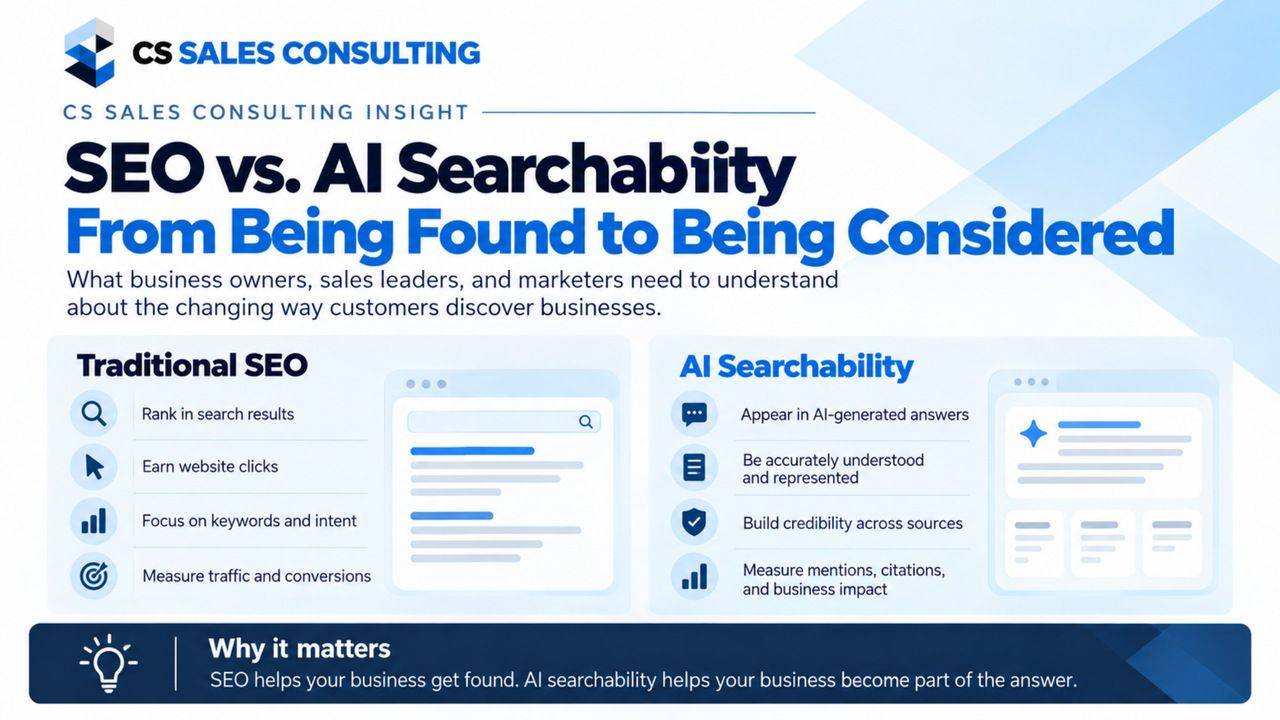
SEO vs. AI Searchability: From Being Found to Being Considered
Oct 23, 2026How traditional search engine optimization differs from AI-powered search, what AEO and GEO really mean, and what businesses should be doing now.
By Chuck Shaver | Founder & President, CS Sales Consulting
For years, businesses have invested in search engine optimization to make sure prospective customers can find them online.
We've optimized websites, targeted keywords, built content strategies, and worked to improve our Google rankings. Those efforts still matter. But the way customers discover and evaluate businesses is evolving.
Instead of simply typing a few keywords into Google and reviewing a list of websites, people can now ask ChatGPT, Google Gemini, Perplexity, Microsoft Copilot, and other AI-powered tools to research problems, compare solutions, and identify companies worth considering.
That raises an important question for every business owner:
What happens when your potential customer asks AI for a recommendation instead of searching for your website?
The answer introduces a concept businesses need to understand: AI searchability.
What Is the Difference Between SEO and AI Searchability?
Traditional SEO helps search engines discover, understand, and rank your website for relevant searches. AI searchability describes how readily AI-powered search and answer systems can discover, understand, accurately represent, cite, or recommend your business when responding to relevant questions.
The simplest way to describe the shift is:
SEO helps your business get found. AI searchability expands the opportunity to become part of the answer.
These approaches overlap. AI searchability is not a replacement for SEO, and traditional search visibility can also influence customer consideration. The meaningful difference is how information is presented and used during the buyer's research process.
Traditional SEO vs. AI Searchability at a Glance
| Traditional SEO | AI Searchability |
|---|---|
| Helps web pages appear in search results | Helps information and brands appear in relevant AI-generated answers |
| Focuses on search intent, technical SEO, content, and authority | Builds on SEO with clear explanations, supporting evidence, and consistent business information |
| Often begins with a keyword search | Often involves detailed, conversational questions |
| Measures impressions, rankings, clicks, and conversions | Adds citations, brand mentions, AI referrals, and business outcomes |
| Encourages people to visit websites for information | Can help people evaluate options before visiting a website |
| Primarily optimizes discoverable web content | Also considers how information is retrieved, synthesized, attributed, and represented |
Neither approach guarantees visibility. And the smartest strategy isn't choosing between them. It's understanding how they work together.
How Traditional SEO Works
Search engine optimization has always been about making relevant information easier to find. A traditional SEO strategy typically includes:
- Technical SEO: Helping search engines crawl and index your pages.
- On-page SEO: Using descriptive titles, headings, relevant language, and useful content.
- Content strategy: Answering the questions people search for.
- Authority and credibility: Earning legitimate links, mentions, and trust.
- Local SEO: Maintaining accurate business information for geographically relevant searches.
- Conversion optimization: Helping visitors take an appropriate next step.
Imagine someone searches Google for: "LinkedIn sales training for B2B companies."
If your business provides that service, strong SEO can improve the opportunity for your website to appear. The typical process is:
Search → Discover → Click → Evaluate → Contact
Of course, traditional search is more complex than this simplified sequence, especially with maps, featured snippets, and AI Overviews. But the basic objective remains: be visible for searches that matter to your customers and provide a useful experience when they find you.
How AI Searchability Changes the Experience
Now imagine a sales leader asks an AI assistant:
We have a 15-person B2B sales team. We're paying for LinkedIn Sales Navigator, but we're struggling to turn connections into meaningful sales conversations. What should we change, and what type of consulting partner should we consider?
That's more than a keyword search. The buyer is describing a business challenge and asking for guidance.
An AI-assisted research tool might respond by discussing prospect targeting, sales process problems, content strategy, messaging, training, or outside consulting support. Depending on the platform and the question, the system may also reference websites, identify service providers, and compare different approaches.
The research experience could become:
Ask → Understand → Compare → Narrow Options → Contact
That creates an important opportunity. A potential buyer may learn about your company, form an initial impression, or develop a shortlist without ever beginning on your website.
Your digital presence therefore has to do more than attract clicks. It needs to communicate your business clearly enough that people and information systems can understand what you offer and why you're relevant.
What Do AEO and GEO Mean?
As AI-powered search has grown, several new marketing terms have emerged.
SEO: Search Engine Optimization
Improving a website's discoverability and visibility in search engines.
AEO: Answer Engine Optimization
A common term for structuring information so answer-oriented systems can find, understand, and present useful responses to questions.
GEO: Generative Engine Optimization
A term for strategies intended to improve content visibility, citation, and representation in generative AI search experiences.
The GEO concept has also been explored in academic research, including the paper GEO: Generative Engine Optimization, published as a preprint in November 2023.
There is considerable overlap among these labels. The industry does not have universally accepted definitions or one standard AI ranking system. For most businesses, memorizing acronyms isn't the priority.
The real priority is making your expertise easy to discover, understand, evaluate, and verify wherever prospective customers conduct their research.
Is AI Really Changing Search Behavior?
Yes, and there is research supporting that conclusion.
Research Finding #1: AI Summaries and Website Clicks
In July 2025, Pew Research Center published findings from an analysis of Google searches made by 900 U.S. adults who shared their browsing activity during March 2025. The research found that:
- When an AI summary appeared, users clicked a traditional search result in 8% of visits.
- Without an AI summary, users clicked a traditional search result in 15% of visits.
- Users clicked a source link within an AI summary in just 1% of visits where a summary appeared.
These are observational findings, not proof that AI caused every difference in clicking behavior. Still, they illustrate why companies need to think about visibility beyond traditional website traffic.
A potential customer may receive useful information about a topic without clicking through to the original sources.
Source: Pew Research Center, July 22, 2025.
Research Finding #2: Microsoft Is Measuring AI Citations
In February 2026, Microsoft introduced an AI Performance reporting capability in Bing Webmaster Tools. The reporting helps website owners see how their content is cited across supported AI experiences, including Microsoft Copilot and AI-generated summaries in Bing.
It provides information about cited pages, citation activity, and the topics or grounding queries associated with those citations. Microsoft explicitly distinguishes citations from rankings, clicks, and measures of source importance.
A website can be referenced within an AI-generated response without receiving a corresponding website visit.
Source: Microsoft Bing Webmaster Blog, February 10, 2026.
Research Finding #3: Google Says SEO Still Matters
Google's official documentation states that foundational SEO practices remain applicable to its AI search features, including AI Overviews and AI Mode. There is no special markup required solely to become eligible for those AI features.
Google continues to emphasize accessible pages, accurate information, helpful content, and established search best practices.
AI search builds on important parts of the existing search ecosystem, even as the user experience and measurement opportunities change.
Source: Google Search Central, AI Features and Your Website.
Why AI Searchability Matters for B2B Companies
This subject is particularly relevant to companies with longer sales cycles, complex services, and buyers who conduct significant research before speaking with a salesperson.
Think about how a B2B buyer evaluates a potential partner. They might research the company's website, look at leadership experience, read educational content, check LinkedIn profiles, examine customer reviews, and ask colleagues for recommendations.
AI can now become another part of that process.
Imagine a prospective customer asks:
Which companies help B2B organizations align sales and marketing, improve executive visibility, and generate better sales conversations through LinkedIn?
If your company does that work, you want publicly available information to describe those capabilities accurately. That means your website, professional profiles, company content, and independent references should reinforce a consistent picture.
This doesn't mean posting frequently on LinkedIn guarantees inclusion in AI answers. It doesn't. It means a coherent digital presence is valuable across multiple discovery and evaluation channels.
Your reputation and positioning can influence the buying journey long before your sales team receives an inquiry.
Seven Practical Ways to Improve AI Searchability
There isn't a secret formula for making an AI assistant recommend your company. But there are sensible, evidence-aligned steps that strengthen both traditional search performance and the information available to AI-assisted research tools.
1. Make Your Website Immediately Understandable
Start with your homepage and core service pages. Can a visitor quickly understand who your company serves, what business problems you solve, how your services work, and what makes your approach different?
Replace vague language with useful, specific explanations. A description such as "We help B2B sales teams improve prospect research, LinkedIn positioning, and relationship-based outreach" provides more meaningful information than "We deliver innovative business transformation."
Clarity helps prospective customers and creates a stronger foundation for machine-readable information.
2. Create Content Around Real Buyer Questions
Think beyond short keywords. What does your ideal customer want to know before purchasing? What obstacles are they experiencing? What alternatives are they comparing?
For example, a company offering B2B sales consulting could publish useful answers to:
- How does LinkedIn Sales Navigator support B2B prospecting?
- What is the difference between sales training and managed prospecting?
- How can sales and marketing work together to improve lead quality?
- What should companies consider before hiring a LinkedIn consultant?
Each topic creates an opportunity to demonstrate expertise. Start with the questions your salespeople already hear.
3. Publish Original Expertise, Not Generic Content
AI has made content creation easier than ever. But generating more pages doesn't automatically make a business more credible or discoverable.
Useful original material might include practical examples from real business situations, explanations of your methodology, lessons learned through implementation, case studies with permission and verifiable outcomes, comparisons that explain trade-offs, and first-hand observations from your industry.
Google's people-first content guidance emphasizes original value, experience, and trustworthiness. Your content should help someone make a better decision, whether AI is involved or not.
Source: Google's helpful, reliable, people-first content guidance.
4. Establish Credibility Beyond Your Website
Your website tells people what you say about your business. Other trustworthy sources may help them evaluate those claims.
This could include legitimate customer reviews, industry mentions, professional association profiles, interviews, relevant directories, and independently published coverage. Avoid paying for fake endorsements or creating misleading third-party references.
The goal is not to manufacture authority. It's to build an accurate, verifiable public record of your experience and work.
5. Align Your Website and LinkedIn Presence
For B2B organizations, this is particularly important. Your website might explain your company's capabilities, while your leadership team demonstrates practical expertise through LinkedIn.
Ideally, both tell the same story. That consistency extends to your company page, executive profiles, educational content, and sales messaging.
If your website promises a particular outcome but your professional profiles don't explain the experience or process behind it, buyers may have unanswered questions.
At CS Sales Consulting, this is a central part of how we think about digital presence. Your company brand and the people representing it should reinforce one another.
6. Review Technical Accessibility
Strong writing isn't enough if important pages cannot be discovered. Make sure your website supports basic search accessibility, including:
- Crawlable public pages and appropriate indexing.
- Clear navigation and useful internal links.
- Important information available in readable text.
- Accurate titles and page descriptions.
- Structured data where it accurately represents the page.
- Appropriate crawler access based on your publishing preferences.
OpenAI documents OAI-SearchBot, a crawler associated with ChatGPT search discoverability, separately from its training-related crawler. Site owners should review crawler controls intentionally instead of assuming every AI bot serves the same function.
Source: OpenAI crawler documentation.
7. Measure Visibility and Business Outcomes
Traditional search metrics still matter. Continue reviewing organic search clicks, impressions, landing-page performance, and conversions.
Then expand your measurement to include AI-related indicators where data is available:
- Citation activity in supported AI search reporting.
- Whether your company is accurately mentioned for relevant research questions.
- Identifiable AI referral traffic.
- Leads who report using AI during vendor research.
- Qualified conversations and resulting pipeline opportunities.
Don't confuse AI mentions with sales results. A company being cited frequently does not automatically mean it is generating more business.
Ultimately, the goal is not to win an AI visibility contest. It's to become easier for the right buyers to discover, understand, and consider.
A 30-Day SEO and AI Searchability Action Plan
You don't need to rebuild your entire marketing strategy overnight. Begin with four manageable steps.
Week 1: Evaluate Your Digital Presence
Review your homepage, service pages, executive LinkedIn profiles, and major business listings. Write down ten realistic questions someone would ask when looking for a company like yours. Test those questions using major AI research platforms and record what appears.
Week 2: Improve Your Website Clarity
Update ambiguous service descriptions, outdated information, and confusing navigation. Add useful internal links, clarify your intended audience, and review basic technical search accessibility.
Week 3: Strengthen Expertise and Evidence
Publish answers to three significant buyer questions. Improve your author information, practical examples, and authentic customer evidence. Make sure your business descriptions are consistent across important properties.
Week 4: Establish a Measurement Baseline
Review traditional search performance. Explore available AI citation reporting. Repeat your sample research questions while recording the exact prompts and dates. Ask new prospects how they discovered your company.
Use the findings to prioritize meaningful improvements. Remember that AI answers can vary between platforms and between repeated searches. Individual tests are useful observations, not definitive performance measurements.
Frequently Asked Questions About SEO and AI Searchability
Is traditional SEO becoming obsolete because of AI?
No. Traditional SEO remains fundamental to helping search engines access, understand, and surface useful information. Google's official guidance confirms that established SEO practices remain relevant to its AI search features.
What is the difference between SEO, AEO, and GEO?
SEO focuses on improving search engine visibility. AEO generally refers to optimizing information for answer-oriented experiences. GEO focuses on the representation and visibility of information in generative AI responses. These approaches overlap and should be considered complementary, not entirely separate disciplines.
How do I get my business recommended by ChatGPT or other AI tools?
There is no guaranteed way to secure a recommendation. Businesses can improve the discoverability and quality of their public information by publishing clear service descriptions, useful original content, credible supporting evidence, and consistent business information. Relevant technical accessibility also matters.
Does LinkedIn activity help AI searchability?
LinkedIn can contribute to a business's wider professional digital presence by providing information about its people, expertise, and published ideas. However, there is no guarantee that a particular AI search platform will retrieve or reference LinkedIn content. LinkedIn remains valuable for B2B credibility and relationships independently of AI search.
How can a business measure AI search visibility?
Useful indicators include citations in supported webmaster tools, identifiable referral traffic, documented tests of brand representation, and buyer-reported discovery sources. Because AI systems and results vary, no single metric represents universal AI visibility.
Should businesses optimize for Google or AI-powered search first?
Start with a strong website, clear positioning, accessible content, and genuine expertise. Those fundamentals support traditional search and provide a useful foundation for AI-assisted discovery. Then measure the channels most relevant to your customers.
The Real Opportunity: Being Considered Before the First Conversation
I've spent more than 25 years in technology sales, and one lesson has remained consistent. People are more comfortable having a sales conversation when they already understand who you are, what you do, and why your expertise might be relevant to their situation.
That's one reason I've spent so much time helping companies improve their LinkedIn presence and business-development strategies.
A professional online presence builds familiarity. Useful content demonstrates expertise. Consistent messaging reinforces credibility.
AI-assisted search introduces another way those things may influence a prospective buyer's research. A customer can begin exploring solutions, comparing providers, and asking detailed questions before ever contacting a company.
We may not control what an AI tool says about our business. But we can control the quality, accuracy, and usefulness of much of the information we publish.
Traditional SEO helps your business get found. AI searchability creates another opportunity to be understood, referenced, and considered.
The objective isn't to chase every new technology trend. It's to make sure your business is represented well wherever your buyers are doing their homework. And when they decide it's time to have a conversation, you want to have given them a good reason to include you.
Connecting Your Digital Presence to Business Growth
At CS Sales Consulting, we help B2B organizations connect brand positioning, digital presence, content, LinkedIn strategy, market intelligence, and practical AI applications with the work of building stronger business relationships.
Whether your priority is clarifying your message, improving executive visibility, strengthening your company's LinkedIn presence, or creating a more coordinated sales and marketing approach, the starting point is understanding the customers you want to reach.
Is your business presenting a clear and credible picture to the people researching you?
Let's explore what makes sense for your business.
Research Sources and Further Reading
- Pew Research Center (July 2025): Google users are less likely to click on links when an AI summary appears. Observational research into search behavior and website clicks.
- Microsoft Bing Webmaster Blog (February 2026): Introducing AI Performance in Bing Webmaster Tools. AI citation visibility and measurement.
- Google Search Central: AI Features and Your Website. Official guidance on SEO and AI search experiences.
- Google Search Central: Creating Helpful, Reliable, People-First Content. Content quality, trust, authorship, and expertise.
- OpenAI Developers: Overview of OpenAI Crawlers. Information about search-related crawler access.
- Aggarwal et al.: GEO: Generative Engine Optimization. Academic research into generative search visibility.
About the Author
Chuck Shaver is the Founder and President of CS Sales Consulting, based in Sioux Falls, South Dakota. With more than 25 years of experience in technology sales, Chuck works with B2B organizations on sales strategy, executive visibility, LinkedIn Sales Acceleration, and connecting digital presence to meaningful business conversations.