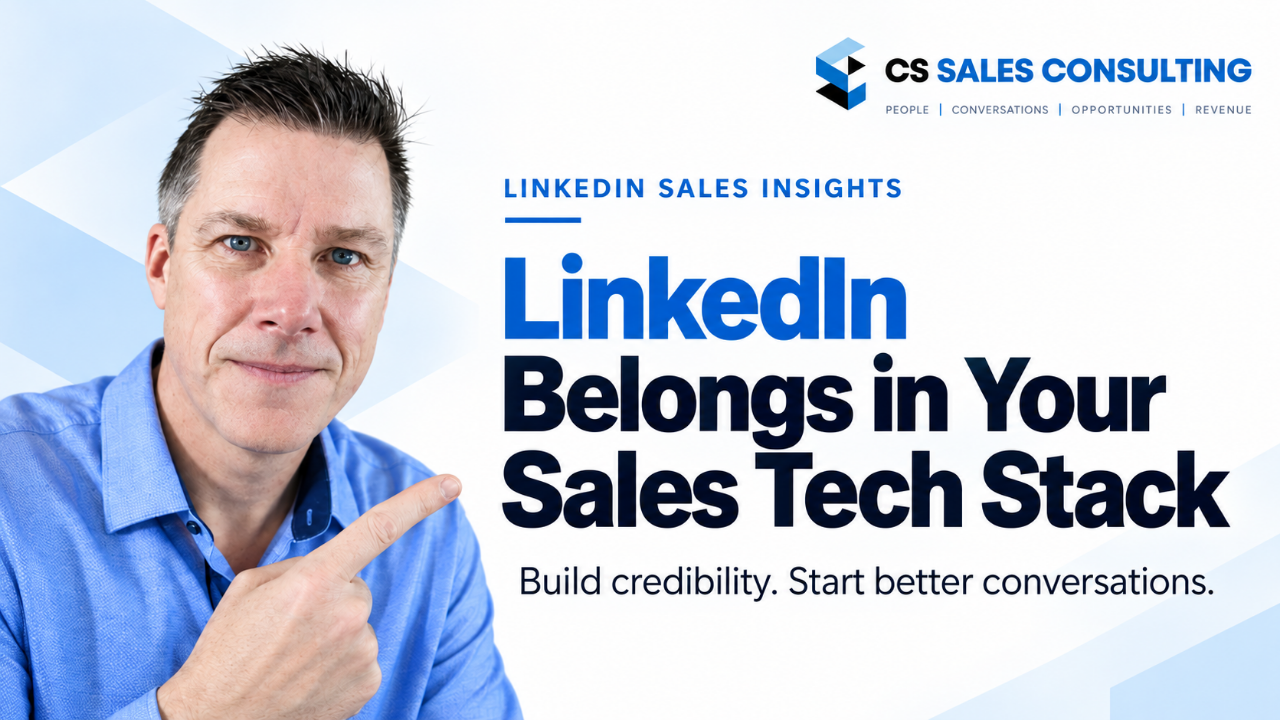
The Most Undervalued Tool in Your Sales Tech Stack Might Be LinkedIn
Oct 19, 2026Originally published September 22, 2026. Updated for CS Sales Consulting.
Sales organizations spend a lot of money on technology.
CRM platforms help manage the pipeline. Prospecting databases help identify people and companies. Sales engagement tools help organize outreach. Conversation intelligence analyzes calls. Proposal and signature platforms help move an opportunity toward the finish line.
All of those tools have value.
But there is another platform sitting in front of most salespeople every day that many companies still don’t treat as part of their sales infrastructure:
LinkedIn.
The difference is where LinkedIn can influence the sales process.
Many sales technologies become important after a prospect has already entered your workflow. LinkedIn can influence what happens before the first conversation ever takes place.
And that makes it worth looking at differently.
Your prospects are researching you too
Salespeople spend plenty of time researching prospects.
We look at the company. We identify the right people. We try to understand what is changing inside the business. We look for possible reasons to start a conversation.
But while you’re researching them, there is a very good chance they are researching you.
Someone receives your email.
They see your name on a meeting invitation.
A colleague mentions you.
You send a connection request.
One of the easiest things for that person to do next is look at your LinkedIn profile.
What happens when they get there?
That moment matters more than many sales organizations realize.
If your profile looks primarily like a résumé, the buyer learns where you worked and what titles you’ve held.
If it is built around the customer, they can quickly understand who you help, the problems you understand, the experience you bring and why a conversation with you might be worth their time.
That is a very different experience.
Your LinkedIn profile is not simply an online résumé.
For a salesperson, it can become a credibility page before the meeting ever happens.
LinkedIn can support much more than prospecting
Too many organizations teach LinkedIn as if it were simply another database.
Find a person.
Send a connection request.
Maybe send a message.
That barely scratches the surface.
Used well, LinkedIn can help sales professionals establish credibility, research accounts, identify decision-makers, discover shared relationships, understand what buyers are discussing, stay visible during long sales cycles and create opportunities through useful content.
Sales Navigator takes that intelligence further.
LinkedIn’s current Sales Navigator search includes filters around company, role, geography, buyer intent, recent activity and relationship paths. It can identify people who recently changed jobs, posted on LinkedIn, viewed your profile, follow your company or, on eligible plans, recently viewed your Company Page.
The platform is also getting better at identifying warmer ways into an account. LinkedIn’s 2026 Sales Navigator updates added stronger warm-introduction recommendations, intent-aware search and improved signals around people and companies showing potential interest.
That is no longer just a contact database.
It is relationship intelligence.
Search is useful. Timing is better.
Finding the right person is only part of prospecting.
The bigger question is often:
Why should I contact this person now?
LinkedIn can help answer that.
A prospect changed jobs.
A company is hiring.
Someone posted about a problem your organization understands.
A buyer began engaging with your company.
A mutual relationship can provide context or an introduction.
An account is showing increased interest.
Those signals give a salesperson something much more valuable than another name on a list.
They provide context.
Sales Navigator can also save lead and account searches and alert users when new people or companies match those criteria.
Alerts around saved leads and accounts can surface changes and activity that create better reasons to reconnect.
That matters because relevant outreach usually starts with understanding what is happening in the buyer’s world.
Your profile has to come first
There is an important catch.
None of these tools work nearly as well if the salesperson’s own LinkedIn presence is weak.
Before teaching someone advanced prospecting techniques, I would start with the foundation.
Their profile.
A buyer arriving at that profile should be able to answer a few basic questions quickly:
- Who does this person help?
- What types of business problems do they understand?
- Why should I believe they know what they’re talking about?
- What can I learn from following them?
- Would talking with this person be useful?
That is very different from building a profile around job descriptions and accomplishments written for a recruiter.
The goal is not to make your profile sound like an advertisement.
The goal is to help someone understand your relevance.
Content plays a role too
Not everyone who sees your content is ready to buy.
That isn’t the point.
Good content gives prospects a chance to understand how you think before they ever speak with you.
A useful post can demonstrate expertise.
A thoughtful comment can create familiarity.
A practical article can answer a question your buyer is already asking.
Consistent visibility can make your name familiar long before an opportunity appears.
Then, when outreach happens later, you may no longer feel like a complete stranger.
That is one of the most overlooked advantages of LinkedIn.
Content and prospecting do not have to be separate activities.
Done correctly, they support each other.
LinkedIn should work before, during and after the sale
I think one of the biggest mistakes companies make is treating LinkedIn as a top-of-funnel tool only.
Find prospects. Connect. Move on.
But relationships don’t stop when a meeting is booked.
LinkedIn can help salespeople stay aware of changes throughout the buying process, remain visible during long decision cycles and continue relationships after someone becomes a customer.
And those relationships may lead to renewals, referrals, introductions and opportunities years later.
That is why I believe LinkedIn belongs alongside the rest of the sales technology stack.
Not because it replaces the CRM.
Not because it replaces email.
Not because it replaces phone calls or real conversations.
It makes those things better when it is used correctly.
Technology doesn't create trust
Companies can continue adding sales technology.
More automation.
More data.
More AI.
More dashboards.
But buyers still have to decide whether they trust the person reaching out to them.
That part has not disappeared.
Salespeople still need to demonstrate credibility.
They still need to understand the buyer.
They still need to create relevant conversations.
And they still need to give another person a reason to respond.
LinkedIn can support every one of those things.
The mistake is treating it as just another place to collect names.
The opportunity is treating it as part of the infrastructure that supports how your salespeople are seen, researched, discovered and trusted.
The most undervalued sales tool may not be the software your company hasn’t purchased yet.
It may be the platform your team already has access to but has never been taught how to use strategically.
Is your sales team actually using LinkedIn as part of the sales process?
CS Sales Consulting helps organizations build the strategy, profiles, prospect targeting, messaging and LinkedIn outreach structure that turns visibility into better sales conversations.